"Look, my fingers are round!"
By Sabine Reber
I am severely nearsighted, and I have always seen only in two dimensions—my brain had never learned to combine the information from both eyes. I had long since come to terms with this limitation, and yet I couldn’t help but wonder—would I be able to relearn three-dimensional vision at the age of 56?
If you have poor eyesight, then basically anything that improves your vision is absolutely fantastic. Contact lenses, progressive lenses, binoculars—even a magnifying glass—are all part of my arsenal of aids in this regard. Good eye exercises, on the other hand, can’t be bought. You have to do the work yourself. And that means practicing regularly, over weeks and months.
Up until then, I had tried conventional eye exercises a few times. The facial exercises and squinting drills were tedious and hardly helped at all. That’s why I was all the more excited about Benita Cantieni’s eye workshop, “Seeing Better.” I’d already experienced some amazing physical results with the CANTIENICA® method. Now I wanted to know if it would work for my eyes, too.
I have a vision impairment of eight diopters, and even with the best optical aids, everything has always looked flat to me—like on a postcard. Several eye doctors had already told me that there was nothing that could be done about it.
To me, though, the world still felt three-dimensional because I’d learned to cope with it. I didn’t walk into lampposts. I could decorate rooms beautifully, design gardens with three-dimensional harmony, draw plans, and bring them to life.
I could even play ping-pong really well—though only on plastic tables. The sound of the ball bouncing provided me with the extra information I needed. When I played on a concrete table, I lost because I couldn’t pinpoint the impact sound on the grainy surface.
I also found it difficult to back into a parking space in unfamiliar places. Aside from these relatively minor limitations, I actually always felt like I could see “normally.”
And now, after the three-day workshop, I actually see in three dimensions!
It’s hard to break down exactly how that came about, or what happened step by step during those three intense days and in the weeks that followed. A lot changed in my subconscious; a good part of the process took place while I slept—as recommended in the course materials, I did a practice sequence every evening before falling asleep.
I also practiced every few hours during the day, whenever I happened to think of it—and because the whole thing was so exciting for me, I thought about it practically around the clock.
It’s hard for me to say exactly which exercises brought about the change. I suspect it’s a combination of several—it’s the variety of different stimuli that makes the miracle possible.
Sometimes my perception becomes flat again when I’m tired or stressed. Then I sit down, close my eyes, and do three or four exercises in a row. Not always the same ones—it works with various combinations.
Now I just follow my intuition and do sequences that come to mind spontaneously. My eyes tell me what they want to do, and after a few minutes, the third dimension is back.
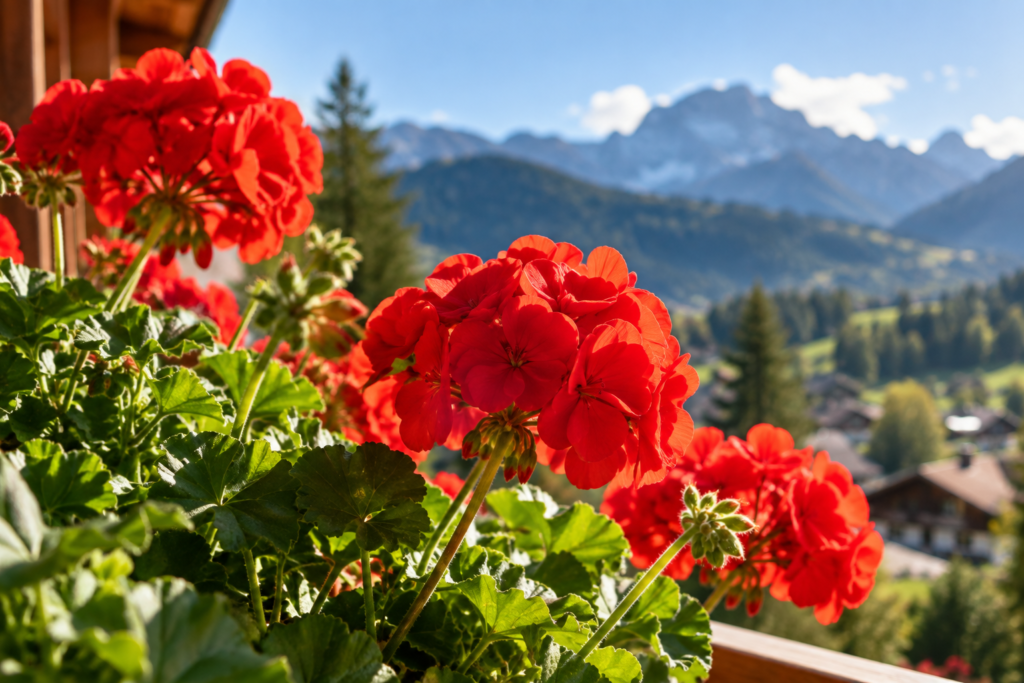
The first time I saw in three dimensions was on the evening of the second day of the course. I was standing on the balcony in Gstaad, staring at the geraniums. They were round! Fire-red spheres—it was unbelievable!
And then I realized that the mountain pine in front of the house also had a round shape. I went for a walk with the dog, and the other trees in the neighborhood suddenly appeared three-dimensional to me as well.
Then I began to look at the individual branches and the leaves. I had to stare at them for a while. Because it was so exhausting, I closed my eyes. When I opened my eyelids again, the branches and leaves also appeared three-dimensional.
After the third day of the course, that evening at the dinner table, I saw a glass in three dimensions for the first time; for a moment, I felt unsure as I poured—the distance seemed deeper.
And then I saw my hands in three dimensions.
I was startled. I set the bottle down on the table. For several minutes, I stared at my fingers. They looked like thick sausages. As if they had only just become flesh in my perception.
My friend asked what was wrong, and I said, “Look, my fingers are round!”
Over the next few days, it happened again and again that I’d pause during everyday movements because I had to reconcile the extra information with my routine.
On the highway, the signs came rushing toward me with vivid clarity, as if I were sitting in a crazy action movie or on a drug trip. I had to stop at the next rest stop.
Back to the small things. The coffee cup, the water glass. My hands.
For a moment, I closed my eyes. I placed them in the hammocks. They wanted to bounce back and forth; I let them. As soon as they’d found their place, I tried to focus on them swaying slowly and evenly back and forth.
Climbing stairs or walking down a mountain trail were additional challenges. I had to adjust my stride with every step and stumbled awkwardly along, just like when I was first learning to see with my first pair of progressive lenses.
Reverse parking also took some time for me to get used to the new dimensions.
Another thing that has changed is the way I move through crowds. In the evening rush at the train stations in Bern or Zurich, I now navigate past the other passengers with a confidence I’ve never had before.
I’ve noticed that the feelings of anxiety that often overwhelmed me in such situations are subsiding. The fact that I can now realistically perceive distances makes the crowd seem more manageable, even harmless.
Now I’m curious to see how my fear of heights will change in a three-dimensional landscape, how exposed rock faces and ridges will appear differently, and what it will be like to perceive powder snow slopes and steep couloirs from a different perspective this winter.
In general, during the training process, I’ve come to realize just how much vision is connected to the subconscious fears that challenge me in various ways.
I don’t know yet where all of this will lead. But I’m very happy that I’ve finally taken the plunge and ventured down this path into the third dimension!
Helvetisms and Linguistic Peculiarities
It took me by surprise: a Swiss expression for “I was curious.”
Couloirs: Steep mountain gullies that are also used as challenging ski runs in winter.
Exposed rock faces and ridges: “Exposed” is a term from mountaineering that refers to terrain where there is a risk of falling.

SEE BETTER – Intensive Workshop with Benita Cantieni
In the intensive workshop “SEE BETTER,” Benita Cantieni teaches how to specifically train the eyes, perception, and body alignment using the CANTIENICA® method.
Next workshop:
January 8–10, 2027
Live via Zoom
Three intensive 90-minute training sessions, accompanied by a training manual, audio recordings, and three months of access to the digital classroom.
CHF 540.– incl. tax